


Hello, lovely readers. Before we get in to the Syncopation Blues, I wanted to apologize for having gone most of this year without publishing anything. It has been a difficult year and I’ve been fairly ill since April. Your prayers are appreciated. It feels like a victory to finally ship something so I hope you enjoy. Peruse the rest of my Silence series as you wish.

Have you ever wondered what the first letter of the Bible is? Given the impossibly brilliant structure of Genesis 1 and the significance of every single detail about the text, one would be foolish, imprudent, silly to assume the first letter of this divine work is not a signal, an easter egg, perfume sprayed on the envelope of the love letter you just received. Now it might not be those things but one would need to check first, expecting something to be there.
One familiar with the symbolic grammar and intricate fractal logic of Torah and the Hebrew language it is written in, might guess the first letter of the Bible to be the first letter of the Hebrew alphabet: the aleph ( א). This would be analogous to the first stanza of the acrostic poem, Psalm 119–what I think of as “the ABCs of Torah”–being the aleph stanza in which each line begins with a word that starts with the letter aleph, the second stanza starting with the second letter, bet (ב), and so on through the alphabet. Aleph would be my choice for the first letter of the Bible. What about you? Thinking as a curious symbolist with a desire to cram into a text as much exposition of the underground of reality as possible, what would you want to communicate with that first letter of scripture? “It was the best of times, it was the worst of times,” or “It was a bright cold day in April, and the clocks were striking thirteen,” but with a single letter.
Btw, have you ever noticed the similarities between Hebrew and Greek? Hebrew begins with aleph, bet…while Greek begins with alpha, beta…there are many other similarities. Not a coincidence. The mind blowing thing to me is that Hebrew, Greek, and therefore English, all share the same common ancestor: Egyptian hieroglyphy. It goes something like this in terms of alphabetic evolution leading to the alphabet used in Torah: Hebrew <- Phoenician <- Proto-Siniatic/Proto-Canaanite <- Egyptian Hieroglyphs. And the crazy thing is, you can swap out Greek for Hebrew in that chain and then trace it back to the characters this essay is written in: English <- Latin <- Greek <- Phoenician <- Proto-Siniatic/Canaanite <- Egyptian Hieroglyphs. Every time you write a capital A you are reproducing an unbelievably ancient symbol of an ox head. You just have to turn that A upside down and you practically have a bull’s skull hanging on your wall: ∀. The aleph, too, has some horns on it: א. Aleph, the ox, symbolizes strength, the leader, the commander.
Speaking of that aleph, are we right in guessing it would be the first letter of holy scripture? On the face of things, the answer is clearly “no” but I think we can turn this into a “maybe” or a “sort of” with some creative thinking. In fact the first letter of Torah is the second letter of the Hebrew alphabet: bet or beth ב. What do we make of this? The first word of the Bible is bereshit, which is typically translated as “in the beginning,” though I prefer to translate it simply as “Beginning.” If the first letter was basically any other letter I would be less suspicious or look for other significance but the fact that the first letter of the Bible is the second letter of the alphabet feels like a clue. Pause for a second and consider: what might God be communicating in these Spirit-breathed characters if this were a clue?

It’s interesting that the aleph is sort of silent in the ancient biblical Hebrew language. The aleph is sort of silent because the main function it serves is as a glottal stop or a breath notation. Think about the word “uh-oh,” where the dash serves as a reminder that this is not the word “uhoh,” there is a little air pop in your voice box that separates the two syllables. Or say the word “ear” as you normally would–it begins with a glottal stop–and if you try to say ear without that glottal stop start you will sound kind of pervy. We might think of the musical notation for a rest in which the absence of sound is inscribed with musical notation. There are also several instances of what is called the “quiescent aleph” in biblical Hebrew in which the letter is entirely silent. If the aleph is silent in its way, wouldn’t it make sense to begin Torah with the bet of bereshit since the absence of the aleph is the perfect way to signify its presence?

And then consider the shape of the aleph. In various Jewish traditions the aleph is thought to be comprised of two other Hebrew letters, yod (י) and vav (ו). To see this, let’s simplify the shape of aleph א into the capital N (these letters are not actually related). Each leg of the N pointing up and down can be thought of as a yod (י) and the diagonal connecting line can be thought of as a slanted vav (ו). And in this symbol we can see the entire cosmos. The arm pointing up signifies the heavens, the arm pointing down signifies the earth, the slant signifies the connecting principle between the two. Vav can actually mean the word “and” and yod can mean “work” or “deed” like a closed hand signifying the completion of an act. The heavens and the earth. And indeed the vav connects the heavens and the earth in Genesis 1:1. So in the aleph we see the heavens, the earth, and the and that joins them.
On the other hand, it’s interesting that the numerological values of aleph and bet are, perhaps unsurprisingly, 1 and 2 respectively. You may have heard that both Hebrew and Greek use the same characters to communicate letters and numbers. So we might say that the first number of the Bible is 2. Which means number 1 is skipped over such that the written Torah begins with a syncopating beat.
There is a midrash (a Jewish commentary on the Tanakh)–or we might call it a folk tale–in which, at creation, all the characters of the Hebrew language line up to see who will have the honor of being the first letter of Torah. Beginning with Tav, the last letter of the alphabet, the letters all arrived and made their case in a presentation reminiscent of the animals presenting themselves to Adam so he could name them.

When Bet came to make her case she explained that, first off, she is the first letter of the word for blessing, barak, as in barukh Atah, or “Blessed art Thou, O Lord.” And isn’t the creator of all things most blessed? And won’t it be a blessing when you command your creatures to be fruitful and multiply? Second of all, she explained that she is the symbol of a house or tent or dwelling, but with the front door open (ב). And isn’t the coming created world one great house of God and one great welcome home to all creatures you will create and isn’t their natural response to thank you and bless your name in response? And so we can see that it is not without meaning that the first written letter of creation is bet.
In the story, the Creator approved of Bet’s plan and thus began holy scripture with bereshit. Aleph resigned herself to not being chosen as the first letter but the Creator honored her humility by announcing that she would be the first letter of the unity of God found in the great Shema prayer of Deuteronomy 6:4, “Hear, O Israel, Yhwh is our God, Yhwh is one.” “One,” spelled out in Hebrew, begins with aleph or ehad אֶחָד. Further, aleph would begin the first of the Ten Words (what you probably think of as the Ten Commandments), Anochi, or the divine “I” of God. As in, “I am the Lord your God who brought you out of Egypt.”
I think this tale about the parade of the Hebrew alphabet actually tells us something about the hidden first letter of the Bible because there is a sacred mystery that comes before that potent bet in bereshit; before the beginning there was the glorious mystery of the divine life, dwelling in eternal perichoretic happiness. We speak of that which we can only dream of. This surely trinitarian reality is wonderful to contemplate and we speak of it with hesitance. Hasn’t God revealed his ehad unity or oneness to be that of love? Isn’t the divine “I” that of the eternal holy community of the Trinity?
I think the first beat is there in the silence of the unwritten aleph. Perhaps it is silence that represents the connecting point between the eternal dwelling of God and that lovely bereshit; perhaps it is the sound of an indrawn breath before the singer begins; perhaps the sigh of the lover; perhaps the two comes out of the one; perhaps in the invisible aleph and written bet there is the systole and diastole of the divine heart.
Aleph: [Inhales] Silence.
Bet: [Exhales] Bereshit. Beginning, God creates the heavens and the land.
First there was the divine mystery–the unity of love, then God begins creating. Maybe the invisible aleph tells us about the joining of the two.
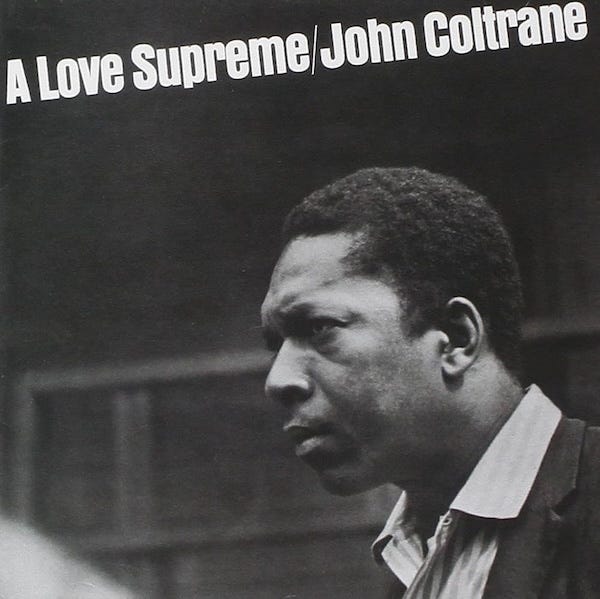
To get an idea of what we’re talking about, I want you to listen to track one, “Acknowledgement,” on the John Coltrane album, A Love Supreme. Use some nice speakers or headphones and do this when you have a minute to relax. Don’t go from abusing your mind by task switching and scrolling straight into trying to appreciate one of the greatest of all jazz albums many view as divinely inspired. When you get the chance, play that first track and imagine the entire ethereal introduction as being the unwritten aleph, the invisible first letter of Torah. The cold wind of the tam-tam awakens you; Coltrane’s tenor sax calls forth sunrise like the lark famous for its ascent; the piano sways like wind chimes welcoming the morning; the eager cymbals whisper the angel’s anticipation; there is no time as of yet. It’s not until around 30 seconds in that the first double bass notes begin to chant the words, “a love supreme,” and creation proceeds. That first bass phrase is the bet of the bereshit.
The pragmatic among you may be wondering, “So how does this knowledge change my life?” or “What do I do with this?” And the skeptical among you may be thinking, “Wow, you can make up basically anything about the Bible.” To this I would only shrug my shoulders humorously, purse my lips thoughtfully, stare off in the distance wistfully.
Love God in all his ways.

Two final notes:
Some who are influenced by St. Maximos and other strains of theophilosophical speculation might consider the issues of temporality and linearity that are (potentially but not necessarily) implied in the above meditation to be problematic but I’d encourage such a person to chill out and just enjoy the prompted contemplation.
If you are that Bible nerd who is jumping out of his chair because I did not say anything about the relationship between Jesus, specifically in the Gospel of John, the letter bet, and bereshit, then props. That is some obscure knowledge I would like to write about at a later time. It should be in this little essay but it’s already been so long since I’ve published anything and I needed to send it. Jesus as the eternal Logos made flesh through whom all things were created is the greater revelation.